
Download a free pdf with building instructions here. The Studio file can be downloaded here.
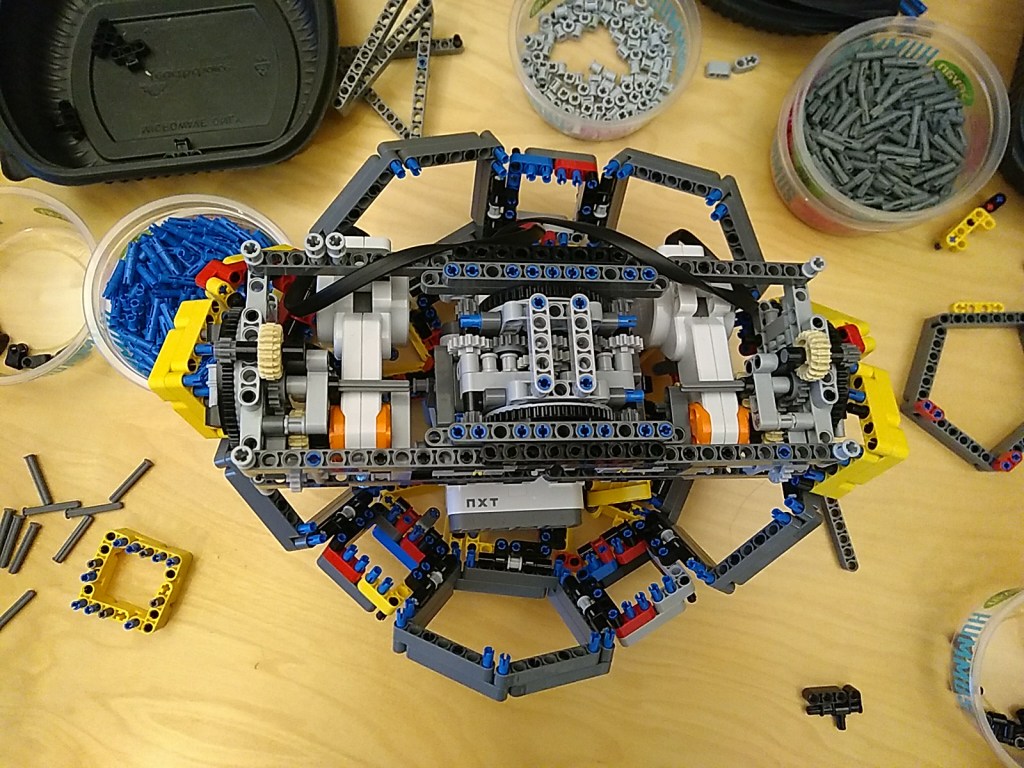
From late 2018, after making the truncated icosahedron, I tried to make a mechanism inside the ball, driven by a Mindstorms brick, to make it roll autonomously. Unfortunately, I did not get it to work. I tried many different versions of the mechanism, but they all failed. The best ones would work for a bit, but then the ball would stop rolling. See the video below. The balls simply was not round enough.
I then worked on that. One idea was to use a different basic shape. The truncated icosahedron is part of a group of more-or-less ball-like shapes called the Archimedean solids. The Wiki page, shows them all, with a ‘sphericity’ number, indicating how close they approximate a perfect sphere. The truncated icosahedron scores comparatively high with 0.9666219. Some others score even higher, and the rhombicosidodecahedron is among those.
A mathematical puzzle
The first design that I made for the rhombicosidodecahedron used the same hinges as the truncated icosahedron. Then something unexpected happened … the parts did not fit. In the picture below on the left hand side, it shows that the two ‘squares’ can not be attached to the pentagon without deforming the shape beyond use for the rhombicosidodecahedron. The fact that the squares are already pushed into a diamond shape is another clear sign that things were … weird.

That was not supposed to happen. After all, it is a geometric shape and the ‘surfaces’ ( squares, pentagons and triangles ) all had edges of equal length ( 7 ) as one can see in the picture. Right? Right. Then why does this not work? It took me a while to realize that the hinges were the problem. But the hinges are neatly in the middle, so that should be okay, right? Moreover, these hinges worked with the truncated icosahedron, right?
Mmmjjjaa, as they say in Sweden, not really. The thing to realize is that the mathematical model of both the truncated icosahedron and the rhombicosidodecahedron exists in the hinges, not in the edges of the surfaces. A hinge from the truncated icosahedron is symmetrical, with the hinge axis in the middle. These axles describe or follow the mathematical model and represent its edges. In the picture above they are only 5L long but imagine that they continue until they cross the axles of the neighboring edges of the same surface. The edges of the mathematical model are longer than those of the Lego surfaces.
This would be fine if all these edges increase with equal factors. Unfortunately they don’t. The expanded edges of the triangle are bigger than those of the squares, and those of the squares are bigger than those of the pentagons. See the left side of the figure below. I.e. the edges are not of the same length and cause the Lego ball to deform.

Solution : different hinges
The solution to the problem is to find a way so that this increase of the mathematical edges does not happen. In practice, I came up with the solution of putting the axles of the hinges on the edges of the triangles and pentagons, as illustrated in the image above, right. For the edges of the squares it does mean that the hinge axles are outside the square because the axles of one hinge can not be on the edges of both the parts that it connects.
One downside of this solution is that the edges of the surfaces are not of equal length. The square’s edges are 6L long, wheres the edges of the pentagon and the triangles are 8L. Another downside is that the corners of the triangles or the pentagons had to be cut. For the triangles this seems easier to do without too much loss of ‘structural integrity’ , i.e. strength.
The truncated icosahedron
But why did it work for the truncated icosahedron? The same hinge problem occurs in that design as well, but the relative difference in edge sizes between its pentagons and hexagons is a lot smaller than the difference between the edges of the triangles and pentagons in the rhombicosidodecahedron. The slack in the Lego version of the truncated icosahedron picks up the small difference. In other words, it is a bit deformed. This means, that as a representation of the mathematical model it is not entirely correct and that the ball has some internal stress to deal with.
Interestingly, the Studio software did notice there was something wrong because many parts did not fit. Studio makes them opaque to indicate this. I thought this was because I was not precise enough with the angles of the hinges in the digital design, and perhaps I was. However, now I think there was this problem going on as well
What about the self moving ball?
In the end, I never built a rhombicosidodecahedron for the self moving ball. After I solved the problem with the hinges, it quickly turned out that the first version that I built was too small for the mechanism. By then it was May 2021, and I got too busy preparing for my migration to Costa Rica. I never got around building a bigger version. I am not even sure I have the materials for a bigger version, and even so, I am not sure that I will get it round enough because the ball still has these huge pentagons.

6 March 2023
Update 17 August 2023 : I added a video of the moving ball after CasperYC’s comment/request.
 Frank van der Most
Do you have a video for the self moving ball?
LikeLiked by 1 person
Hi CasperYC, thanks for your interest. I uploaded a video and integrated it in this page.
LikeLike