
1 About the MOC
MOC – 31154 Dinosaur Fossils is designed by Nequmodiva and published on Rebrickable in 2025. It is an alternate build with bricks from Forest Animals: Red Fox.
2 Overall impressions
This is a cool alternate build in which you get two skulls. One of a Triceratops in mostly white bricks and one of a T-Rex in mostly brown bricks. I am no dinosaur expert, so I had to look up some images online. The skulls look convincing when compared to the online images. With the T-Rex I initially had two doubts. The back of the skull seems too flat and the eye socket could be clearer. But it turns out, both are shaped as they should: the T-Rex has a rather flat back of the skull and the eye sockets are not round at all. In fact, just from the skull images, I wouldn’t be able to tell which holes are the eye sockets
What comes out well in the design is the messiness of skulls and the fact that they are not solid things, but in fact very open and have an endless amount of angles.
I enjoyed building this MOC a lot. In part because I had never built a model of a skeleton before and in part because I learned a some new building techniques.


3 What I have learned
I have learned quite a few things from this MOC. Firstly, designing skulls and skeletons is different from designing as demonstrated by the Red Fox. I learned a new way to make hinges, and I learned the secret of brackets, which will help me a lot, the next time that I am working with them.
Method for building skulls and skeletons
First of all, the endless amount of angles and the very open structure make it difficult to design something that is strong enough. Typically, it requires a different type of building method than you find in the Red Fox set. All 3 models of that set are literally solid as a brick. I would summarize that method as: start with some big bricks as core, hang them with brackets, and add layers of plates. With skulls, the core is missing and that makes a big difference. ( Okay, the lower jaw of the T-Rex does have a solid core ). The stability apparently is is provided by small bridges and the layers of plates. And it surely works. When finished the skulls feel as solid as the Fox’s body, just a lot lighter.

( the side panels from the skull’s left side are not shown )
Mixing clips and teethed hinges
Having far more experience with designing Technic models than anything else, I learned a few things about regular – that is non-Technic – bricks.
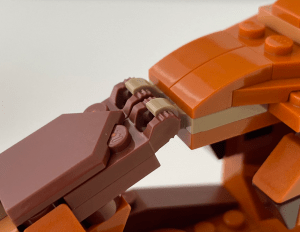
Apparently, clips ( like these ) can hinge with teethed hinges ( like these ). See the image to the right. The connection is not particularly strong, but if that does not matter than it works fine. In the T-Rex, the nose bone is hinged like this on the top end, whereas the other end tucks nicely behind an obstacle, so the nose bone is not going anywhere.
Bracket dimensions
The dimensions of brackets and bricks with side-wards looking studs have puzzled me for a while. When it comes to the brackets, I finally learned the secret of the thickness of the vertical panel on a bracket. The side assembly of the T-Rex’s upper jaw shows it plain and simple:

So the 1-stud unit plate width plus the thickness of the panel of a bracket is exactly the size of three plates stacked upon each other, that is the hight of a brick ( not counting the stud ). That is damn handy.
Then I started checking some more. It turns out that the bracket’s panel plus two plate heights equals a 1-stud unit, which is also good to know. Unfortunately, in the photo below it seems as if the brick is a hair or two thicker than the panel plus the plates but that is because of the camera’s angle, which was no exactly straight.

5 Possible improvements
As with most if not all alternate builds, one needs to comprise at times because the necessary bricks simply are not included or can not be taken from elsewhere in the alternate design. However, in this case, I dare to say that both skulls should and can be improved where their stands are concerned.
Let me start with the Triceratops where the skull rests on just one stud which is located in front of the skull’s center of gravity. The friction of that one stud keeps the skull from toppling over. That could better be four studs. The bottom of the stand touches the floor with just four studs, and here too, some more stability could be introduced. I will give you the pictures, and you should be able to figure it out.


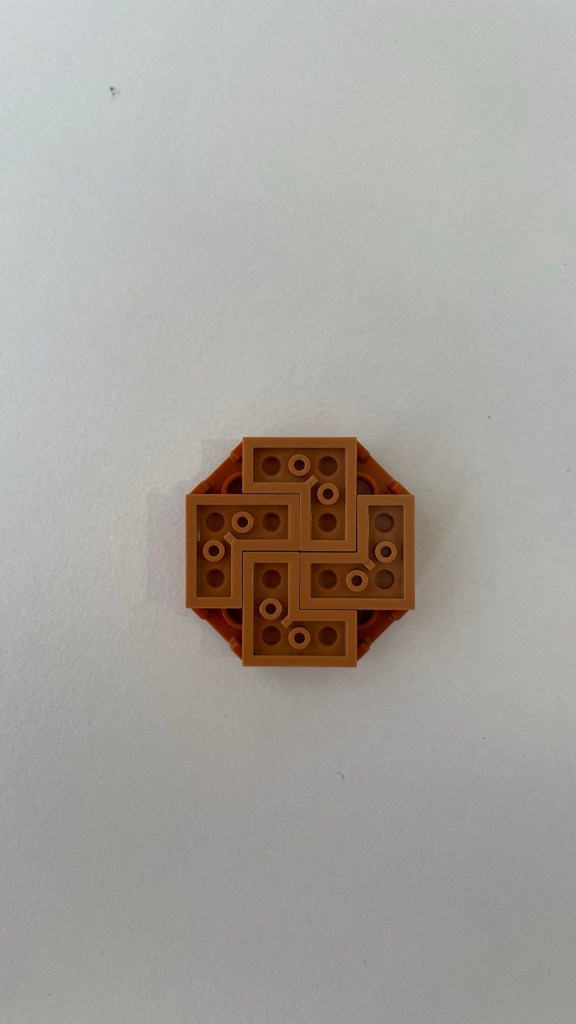
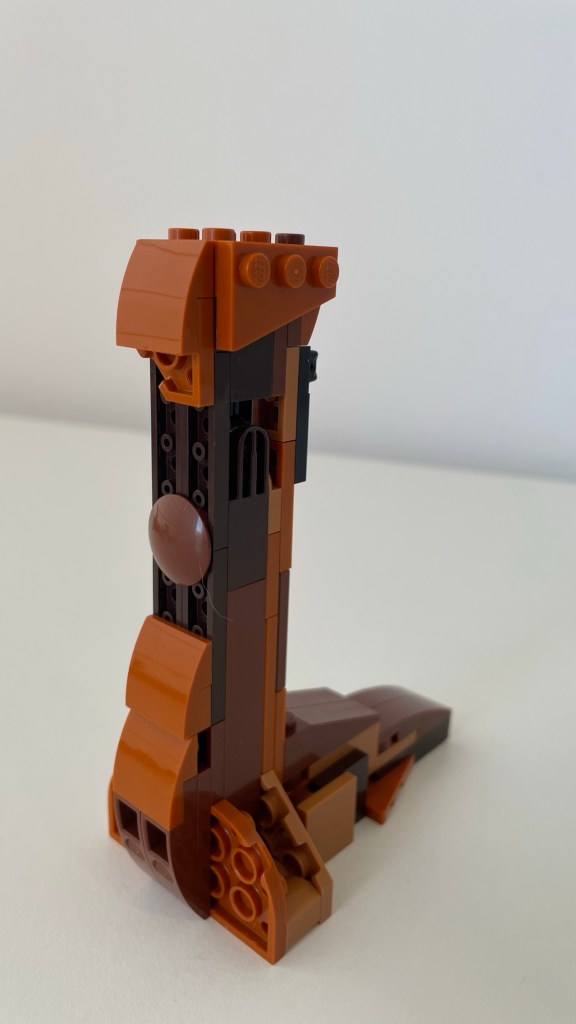
The T-Rex skull does connect to its stand with four studs and the stand has a bigger base that is clearly designed for the much bigger and heavier skull. However, these four studs are very close to falling short. I would prefer to extend them with four more, but I did not see a good solution without sacrificing the 2×3 inverted slope that so nicely shapes the inside of the back of its mouth. I do see how to extend the connection with two more studs, and I believe the vertical part of the stand could do with reinforcements. In fact the base of the stand is not very sturdy either. When I tried to improve it, I found that it would require some mayor re-design. I decided not to go there, because when I tested the stand with the changes that I mentioned, it turns out that the skull will sooner let go of the stand than that the base of the stand will fall apart.
Without further ado, here are pictures that show the changes.



About Mini MOC Reviews
I make no promises, but it could be that I will be writing more reviews in this format. I realized that I have been learning a lot from my own MOC making, but that I could learn a lot more from looking at other people’s MOCs.
Mini MOC Reviews are brief reviews of other people’s MOCs. They are not full blown reviews with lots of images of different build stages, historical overview of a theme, interviews with the designer. They just have three sections: Overall impressions, What have I learned, and Possible improvements.
 Frank van der Most